
Rite of Passage
The Figures of Baptism and the Biblical Basis for Baptizing Infants

I had planned to write this exact article almost a year ago. Since then, I have changed my mind and taken the opposite position. This will come as a surprise to no one more than me. The reason I finally decided to write this article is precisely because I need to parse out why and how I could have possibly changed my mind—and if I truly have. More than anyone, I am trying to convince myself, and if I do, I hope also to convince you, dear reader. You may already agree with the conclusion of this article. You may have agreed with me before I reevaluated the evidence. Either way, may this article give you a new perspective. I am not a historian, nor a theologian. Most fundamentally, I am a student. I am a disciple of the Lord Jesus, and I love to learn. I love to read books for the sake of hearing something interesting, something I have never heard before. So may this article offer you a new and interesting perspective on the sacrament of baptism.
Foreskin & Water
What does circumcision have to do with baptism?
After Abraham and Sarah’s shameful abuse of Hagar, Yahweh appeared to Abraham and said, “This is my covenant with you and your descendants after you, the covenant you are to keep: Every male among you shall be circumcised. You shall be circumcised in the flesh of your foreskins, and it shall be a sign of the covenant between me and you.” (Gen. 17:10-11). Circumcision was a physical sign of one’s relation to the family of Abraham and Yahweh’s covenant with them. It was the rite of passage for every infant son, to remind them physically and permanently of their unique calling and relationship to the Creator of the cosmos. However, after the ascension of Christ, Saint Paul, reflecting on circumcision writes:
“Blessed are those whose transgressions are forgiven, whose sins are covered. Blessed is the one whose sin the Lord will never count against them.” [Psalm 32]
Is this blessedness only for the circumcised, or also for the uncircumcised? We have been saying that Abraham’s faith was credited to him as righteousness. Then how was it credited? Was it after he was circumcised, or before? It was not after, but before! And he received circumcision as a sign, a seal of the righteousness that he had by faith while he was still uncircumcised. So then, he is the father of all who believe but have not been circumcised, in order that righteousness might be credited to them (Rom. 4:7-11, emphasis added).
It was not circumcision that was credited to Abraham as righteousness but his faith in the promise of a seed—“For if a law had been given that could impart life, then righteousness would certainly have come by the law” (Gal. 3:21b). Under the new covenant, those who devote themselves to Yahweh and his Anointed are no longer required to circumcise their sons. As Paul writes elsewhere, “Circumcision is nothing and uncircumcision is nothing. Keeping God’s commands is what counts” (I Cor. 7:19). Circumcision was meant to serve as a sacred reminder of Israel’s calling to be a kingdom of priests, but it could never directly affect the heart. Thus, Jeremiah prophesied, “Circumcise yourselves to Yahweh; remove the foreskin of your hearts” and “‘The days are coming,’ declares Yahweh, ‘when I will make a new covenant’” (Jer. 4:4, 31:31, emphasis added). Circumcision worked as a sign, but it was completely ineffective—simply put, circumcision cannot forgive sins. As the author to the Hebrews explains, “For if there had been nothing wrong with that first covenant, there would have been no need to look for a second” (Heb. 8:7). As the whole of the Hebrew Scriptures attest, clearly the old covenant was inadequate—we need the promised seed (Cf. Gen. 3:15 Gal 3:16-19a).
Thus, the new covenant demands a new rite of passage: baptism. Our English word is simply a transliteration of the Greek word which means immerse, submerge, wash or drench in water.1 While ceremonial washing had been a common temple practice, John the Baptist, an outsider from the inside, made the politically and religiously charged claim that the descendants of Abraham needed to be reinitiated into the Promised Land through the Jordan River. In other words, this voice of the wild demanded individual repentance for both men and women, despite their familial relationship to the covenant. John would not be satisfied by pharisaical solutions (e.g. stricter adherence to the Torah and performative religion), he insisted on national revival, or else they would face utter annihilation and excommunication from God’s royal supremacy.
If this form of submersion existed as a reorientation for the forgiveness of moral errors (Mark 1:4), then in why does Jesus—God become flesh—come to John to be immersed in the Jordan? In one sense, “To fulfill all righteousness” (Matt. 3:15). But we could ask the same question another way—why does Jesus allow himself to be crucified? The answer: for our sake, to fulfill all righteousness. As the Nicene Creed asserts, “We believe in one baptism for the forgiveness of sins.” There is only one baptism—Jesus’ baptism: his death and resurrection (Cf. Eph. 4:5). Therefore, Saint Paul asserts, “Don’t you know that all of us who were baptized into Christ Jesus were baptized into his death? We were therefore buried with him through baptism into death in order that, just as Christ was raised from the dead through the glory of the Father, we too may live a new life (Rom. 6:3-4, emphasis added). Unlike circumcision, this rite of passage into the body of Christ truly affects our souls. It is a sign, but not merely a sign—baptism is the means by which God saves us. Saint Peter asserts:
Christ also suffered once for sins, the righteous for the unrighteous, to bring you to God. He was put to death in the body but made alive in the Spirit. After being made alive, he went and made proclamation to the imprisoned spirits—to those who were disobedient long ago when God waited patiently in the days of Noah while the ark was being built. In it only a few people, eight in all, were saved through water, and this water symbolizes baptism that now saves you also—not the removal of dirt from the body but the pledge of a clear conscience toward God. It saves you by the resurrection of Jesus Christ, who has gone into heaven and is at God’s right hand—with angels, authorities and powers in submission to him (I Peter 3:18-22, emphasis added).
We are saved by our submersion in Christ’s death and emergence from the water in his resurrection (Cf. Rom. 6:5). Baptism is not a mere ritual—it truly cleanses us, washing us whiter than snow. Saint Paul further explains:
For in Christ all the fullness of the Deity dwells in bodily form, and in Christ you have been brought to fullness. He is the head over every power and authority. In him you were also circumcised with a circumcision not performed by human hands, by putting off the body of the flesh, by the circumcision of Christ, having been buried with him in baptism, in which you were also raised with him through your faith in the working of God, who raised him from the dead (Col. 2:9-12, emphasis added).
Jesus did not come to abolish the Torah but to “fulfill it” (Matt. 5:17). Therefore, just as infant sons of Israelites were circumcised by virtue of their familial status, infant boys and girls may be baptized, circumcised in Christ, for the forgiveness of sins, being adopted into the household of God. The rite of circumcision belonged to the Israelites, and now, as followers of the slaughtered yet standing Lamb, our Lord gives us the rite of baptism, the true fulfillment of circumcision.
Out of the Mouth of Babies and Infants
How can an infant have faith?
To many, it seems wildly inappropriate to induct dumb, helpless infants into the Church through the sacred rite of baptism—they cannot make vows or a profession of faith or give a rousing testimony! Ironically, Jesus reprimanded his disciples for an eerily similar posture: “And people were bringing babies [Gk. paidia] to Jesus for him to place his hands on them, but the disciples rebuked them. When Jesus saw this, he was indignant. He said to them, ‘Let the babies come to me, and do not hinder them, for God’s Rule belongs to such as these’” (Mark 10:13-14). For the disciples, Jesus’ ministry means subversive, political rebellion through militaristic tactics leading to a bloody conflict. What do babies have to do with overthrowing the Romans? They fundamentally misunderstand the nature of Jesus’ kingship and his messianic mission. Jesus completely flips the social hierarchy: do not hinder these infants, because they are the true heirs to God’s glorious throne. How is this possible?
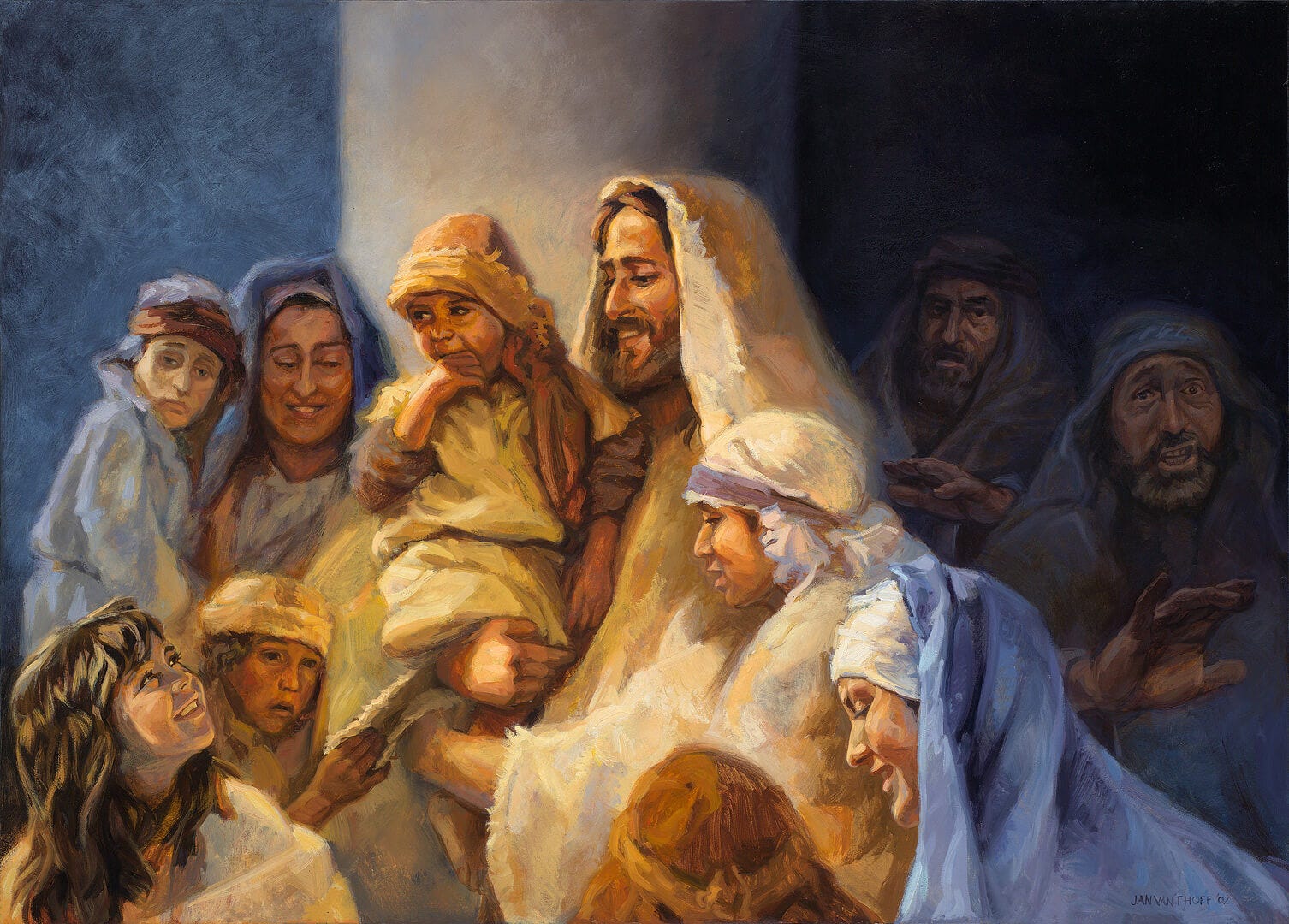
In another scene, Jesus tries again to help his students understand: “And he said: ‘Truly I tell you, unless you change and become like babies, you will never enter the rule of the sky. Therefore, whoever takes the lowly position of this baby is the greatest in the rule of the sky’” (Matt. 18:4). Jesus’ teaching infers that babies naturally assume the posture needed to join God in ruling Creation. This posture embodies what the word faith means. The Greek word connotes devotion, dependence, conviction, and trust. The same King David who wrote: “Behold, I was brought forth in iniquity, and in sin did my mother conceive me” also wrote, “From birth I was cast on you; from my mother’s womb you have been my God” (Ps. 51:5, 22:10). David speaks of both his natal bond to sin and his passive union with God as an infant. Someone threw him upon God, and God himself claimed David as his own: “I have made you and I will carry you; I will sustain you and I will rescue you” (Isa. 46:6). By their very being, infants “recognize” that they are poor and needy creatures utterly dependent on their Creator.
As jaded adults, this vulnerable disposition often escapes us. For children, trust is their native tongue, but for many of us who have encountered the harshness of this cursed land, trust has become a foreign language—an accent we desperately tried to subdue. Those who fail to obtain street smarts are labeled gullible and naïve. Independence has grotesquely morphed into a core value.2 We may then rightly respond, “Who then can be saved?” Jesus gently reminds us: “With man this is impossible, but with God all things are possible” (Matt. 19:26). If God can save calloused adults, how much more can he save the little children? In fact, Yahweh our Lord not only saves them, but “out of the mouth of babies and infants, you have established strength because of your foes, to still the enemy and the avenger” (Ps. 8:2).
Headship & Representative Faith
What gives us the right to baptize infants?
Baptism requires both individual and communal responsibility. Undeniably, the communal comes first: baptism assumes passivity (one cannot baptize himself)—all of us came to faith because of one or more relationships with those already following our Lord. Thus, Jesus gives the Church the rite of baptism to initiate new converts. Indeed, he commands us to do so, “All authority in heaven and on earth has been given to me. As you go, therefore, disciple the nations, baptizing them in the name of the Father and of the Son and of the Holy Spirit, and teaching them to obey everything I have commanded you” (Matt 28:18-19). How do we disciple the nations? We initiate them (baptism) and teach them (catechism). But what gives us the right to do so? It is from his ultimate position of all-encompassing authority that Jesus gives his chosen ambassadors the privilege of bringing sinners through the waters of death into the Promised Land. And he commands us not only to baptize in his name but in the mighty strength of the threefold name of the Trinity: Father, Son, and Holy Spirit.
This idea of authority or headship has become increasingly unpopular in the West. We should not, however, squirm at the thought of hierarchy—the structure of the universe is hierarchical. Everyone has a body with many parts, but only the head controls the body. Every team has a “head” coach. Every military has a sophisticated architecture of leadership that can order the whole—this is simply how the world works. Humans have traditionally understood the arch of a man’s life as building a body for himself: “Therefore a man shall leave his father and his mother and hold fast to his wife, and they shall become one flesh” (Gen. 2:24). Just as every body has one head, every family has one “head,” the father—that is why a man, once he starts his own family through marriage, must leave his father for the sake of his wife. Is this not what the Son did for us? As Saint Paul explains, “For the husband is the head of the wife as Christ is the head of the church, his body, of which he is the Savior” (Eph. 5:23). Every husband is the head of his household for which he must offer himself as a living sacrifice in love, and Christ is the head of the Church for whom he suffered and died. Paul also writes, “I want you to realize that the head of every man is Christ, and the head of the woman is man, and the head of Christ is God” (I Cor. 11:3). Imagine a tree—it has a single trunk that eventually branches out, and those branches have branches, and those branches have smaller branches, and those branches have many sticks, each with many leaves. “I am the vine; you are the branches.” (Jn. 15:5). Like the shape of the mountain, Moses oversaw Israel as the top of the hierarchy, appointing officials over thousands, hundreds, fifties, and tens—each group a microcosm of the whole (Ex. 18:21). Once we grasp this basic structure of reality, the idea of a father, as the head of his family, baptizing his child into the Church makes good sense.
The concept of headship applied to baptism is even present in Saint Luke’s account of the initial spread of the Way:
The jailer called for lights, rushed in and fell trembling before Paul and Silas. He then brought them out and asked, ‘Sirs, what must I do to be saved?’ They replied, ‘Believe in the Lord Jesus, and you will be saved—you and your household.’ Then they spoke the word of the Lord to him and to all the others in his house. At that hour of the night the jailer took them and washed their wounds; then immediately he and all his household were baptized” (Acts 16:29-33).
Whether or not infants were present cannot be proven, but it remains besides the point. It seems most likely that the family members are baptized and saved because of the belief of the father. In the ancient world, one’s cultic life depended on the devotion of one’s master or father, the head of the household. As the head, the jailer had the authority to convert everyone under his roof.
If the notion of headship still seems suspect, one cannot deny the communal role of the Church. In the famous scene of, most certainly, a group of teenagers breaking open the roof of a house so that they can lower their paralytic friend down to Jesus, Saint Mark writes, “When Jesus saw their faith, he said to the paralytic, ‘Son, your sins are forgiven’” (Mark 2:5, emphasis added). Shockingly, Jesus forgives this young boy because of the faith of his friends!3 Forgiveness and healing cannot come through solitary prayer—it can only come through the body of Christ (Cf. James 5:14). I have personally witnessed miraculous healing through the power of communal faith by applying this passage. Alcoholics Anonymous, for example, cannot function without meetings and sponsors—all of us need weekly meetings of worship to remind us of the cosmic reality of absolution and faith-sponsors to save us from our addiction to sin and self-harm. When parents present their child for baptism, and the assembly of believers gathers around them, Jesus sees their faith and says to the child, “Your sins are forgiven.”
Emotional vs. Spiritual
What if the child never remembers this pivotal moment?
While spiritual experiences most often generate deep, affecting responses, we should not equate these two faculties. Taking a biblical biology as the most accurate description of the human soul, the spiritual comes from above (the heavens, head, mind, ideas, breath, thoughts, abstractions, etc.), while the passions come from below (the deep, body, the gut, feelings, desires, potential, etc.), both mediated by the heart.4 One can have an emotional experience through many accessible avenues: drugs, kissing, sex, video games, sports, art, music, and pretty much every other activity under the sun. Spiritual experiences, on the other hand, cannot be forced. These include visions, dreams, epiphanies/enlightenment, revelations, prophetic words, sanctification/mortification of sin, healing, divine presence, and many others. While an awareness of sinfulness may inculcate sorrow, healing incite ecstatic joy, and visions provoke wonder, these come from different places. Feelings come from within, and grace comes from outside, from God.
Since baptism marks the beginning of a person’s journey, the entry rite into the wilderness and/or the Promised Land, we should expect that this experience will not be one’s only spiritual experience or even the most significant. My baptism is important and meaningful to me. However, I’ve had countless more impactful encounters with the living God. Baptism is not the only way to feel the love of the Father or the presence of Jesus or the moving of the Spirit. Now, that is not to disparage baptism. Rather, baptism is the first step in a lifelong pilgrimage, one full of incredible miracles. If an infant does not remember his/her baptism, this in no way diminishes their personal relationship with God.
He Takes No Pleasure In Fools
What if the parents don’t take baptism seriously?
One of a myriad of reasons I have chosen to become Anglican over other denominations is their emphasis on the gravity of baptismal vows. During the liturgy, the priest explains:
Today, on behalf of this child, you shall make vows to renounce the devil and all his works, to trust God wholeheartedly, and to serve him faithfully. It is your task to see that this child is taught, as soon as he is able to learn, the meaning of all these vows, and of the Faith that you will profess as revealed in the Holy Scriptures. He must come to put his faith in Jesus Christ, and learn the Creeds, the Lord’s Prayer, the Ten Commandments, and all other things that a Christian ought to know, believe, and do for the welfare of his soul. When he has embraced all these, he is to come to the Bishop to be confirmed, that he may publicly claim the Faith for his own and be further strengthened by the Holy Spirit to serve Christ and his kingdom.
Are you willing and ready to undertake this?5
The liturgy strictly forbids flippancy. All parents who wish to baptize their child must make weighty vows that they will instruct their child diligently, teaching him/her to obey everything that Jesus commanded, and bring him/her before the Ecclesial shepherd of the flock to be examined (Cf. Matt. 28:18-20). While the possibility of parents ignoring the seriousness of this task always remains, no matter the liturgy or denomination, God alone presides as judge and avenger—we need not worry about enforcing divine law. As Ecclesiastes asserts, “When you make a vow to God, do not delay to fulfill it. He has no pleasure in fools; fulfill your vow…Why should God be angry at what you say and destroy the work of your hands?” (Eccl. 5:4, 6). Vows have consequences, and God is not mocked—baptism, especially baptism, is no exception. Whether or not parents decide to baptize their child, we must agree that parents bare a deep responsibility to catechize/instruct their children (Cf. Deut. 6:1-12).

Certainty and Biblical Figures
Where did Christians get this idea?
Despite these explanations, some may still scoff at the notion of baptizing an unconscious child. “Nowhere in the Scriptures does God teach infant baptism,” I remember myself saying. This objection resonates. It feels dubious to take one of the most sacred rites and practice it in a way never explicitly outlined. Nevertheless, the Scriptures are too complicated simply to accept this criticism. The Church has always read the Scriptures figurally—as the Word of God, the structure and pattern of reality, unconstrained by history. The Scriptures never spell out the doctrine of the Trinity, and yet, they speaks of it clearly. Thus, I would like to trace a very brief figural reading of baptism through the Scriptures to demonstrate the coherence of infant baptism in the biblical witness. The following paragraphs each illustrate a different figure of baptism.
In the beginning, the chaotic deep of raw potential raged in the heavy void, and God’s activating breath flew and fluttered over the waves (Gen. 1:2). From these dark waters, God inspired, cut, portioned, designed, and fashioned the cosmos through his Word, the Divine Blueprint and Architect (Prov. 8:22-31). He divided the depths, setting a boundary and placing the heavens between them (Gen. 1:6-8). These he did not permit to escape until the days of Noah, and never after.
When the sons of God and daughters of man abandoned their identity, Yahweh caused the cosmos to crumble once more into disarray, but Noah found grace in the eyes of Yahweh (Gen. 6:1-8). God saved Noah and his children in the ark from the destruction of the raging abyss, bringing them safely through the waters (Gen. 7-8, I Peter 3:18-22). After forty days, when the breath dispersed the seas, Noah sent out a dove to explore the new land (Gen 8:6-12).
During the Exodus, Yahweh split the sea by his breath, leading the children of Israel—men, women, and children—through the deadly sea with a wall of water on their right and a wall of water on their left (Ex. 14). Through the waters, he led them out of their slavery in Egypt into the bitter desert. All who stood with Pharoah were swallowed up—not one survived, and there they lay, never to rise again, extinguished, snuffed out like a wick (Isa 43:17). There, he crushed the heads of Leviathan and gave its carcass as food for vultures and beasts (Ps. 74:13-14). When the children of Israel arrived at the border of the Promised Land, they passed through the Jordan River on dry ground.
In the days of kings, Isaiah prophesied of an age when Yahweh would pour his breath on our seed like streams in the desert, and they will spring up and flourish like trees in a garden (Isa. 44:3-4). In that day, Yahweh will pour out his breath on all flesh, men and women, young and old, slave and free (Joel 2:28-29). They will pass through the waters unharmed and the flames unburned—children from the north, south, east, and west—to a place of abundance (Isa. 43:1-7, Ps. 66:12).
After the exile, a man named John appeared in the desert, proclaiming an immersion of repentance into freedom from errors (Mark 1:4). At that time, Jesus came from Nazareth in Galilee and was submerged in the Jordan River by John and the Holy Breath descended on him as a dove (Mark 1:9-10). No one can see God’s sovereign rule except those born above—that is, born of water and breath (John 3:1-15). Everyone immersed will be freed from errors and receive the Holy Breath—this promise is for us and our children and all who are far off (Acts 2:38-39).
When the priest baptizes an infant, he reenacts this reality. The child enters the choking Nile—the chaotic abyss of precreation—with the helpless sons of Israel, but like Moses, passes through the tumultuous deluge, inspired with Divine Fire, and received into the Ark of the Church. The Father, through the incarnation, baptism, life, death, and resurrection of the Son, by the Holy Breath, frees the child from the house of slavery. Through this Red Sea, this Jordan River, the child enters both the wilderness of sanctification and the Garden of abundant life. As the child meditates on the perfect Torah, he/she will grow like a tree planted by streams of living water (Ps. 1).
New Beginnings
This article exists neither to divide nor compel. I began this project simply as an exploration of an alternative reading. At the very least, I hope it exposed the lavish riches of what the Scriptures say about baptism and provided deeper insight into why Christians perpetuate this ancient practice of initiating babies. While many will still disagree with my conclusion, I hope the biblical case is clearly visible.
If we baptize our children, it will not be merely based on tradition or Anglicanism or a need for assurance, but because we believe that the Scriptures teach it. This has not been an easy or painless process—it is a complete paradigm shift, and one we do not accept lightly. As Elizabeth and I continue to wrestle with these ideas, we hope those on both sides of the debate will accept us with grace.
Peace to you all.
For more reading on this topic, check out these wonderful pieces by Bryce Lowe:

Although I would prefer to use the word immersion, since I am referring to the Christian rite in a technical sense, I will use the word “baptism” throughout this article.
That’s right. I went there: @ Grove City College. The problem is not independence in and of itself but independence as a core value. Independence as a core value suggests that dependence, the state that every human naturally assumes, is fundamentally detrimental to individuals and society. This directly contradicts the idea of a body with many parts (Cf. I Cor. 12:12-30). For further reading on this topic, check out Carl Trueman’s The Rise and Triumph of the Modern Self and Kelly Kapic’s You’re Only Human.
Nowhere in the Greek text does the word “man” appear. That Jesus refers to him as “son” indicates that the paralytic was very likely a young boy, based on ancient Jewish customs. It would be inappropriate for Jesus to call a grown man “son.” Thanks to Dr. Josiah Hall for pointing this out to me.
For those of you who read my last article, Abel is the spiritual, Cain is the emotional, and Seth is the heart.
Book of Common Prayer 2019.